XGIMI Titan Noir Max vs Horizon 20 Max: 4K Test
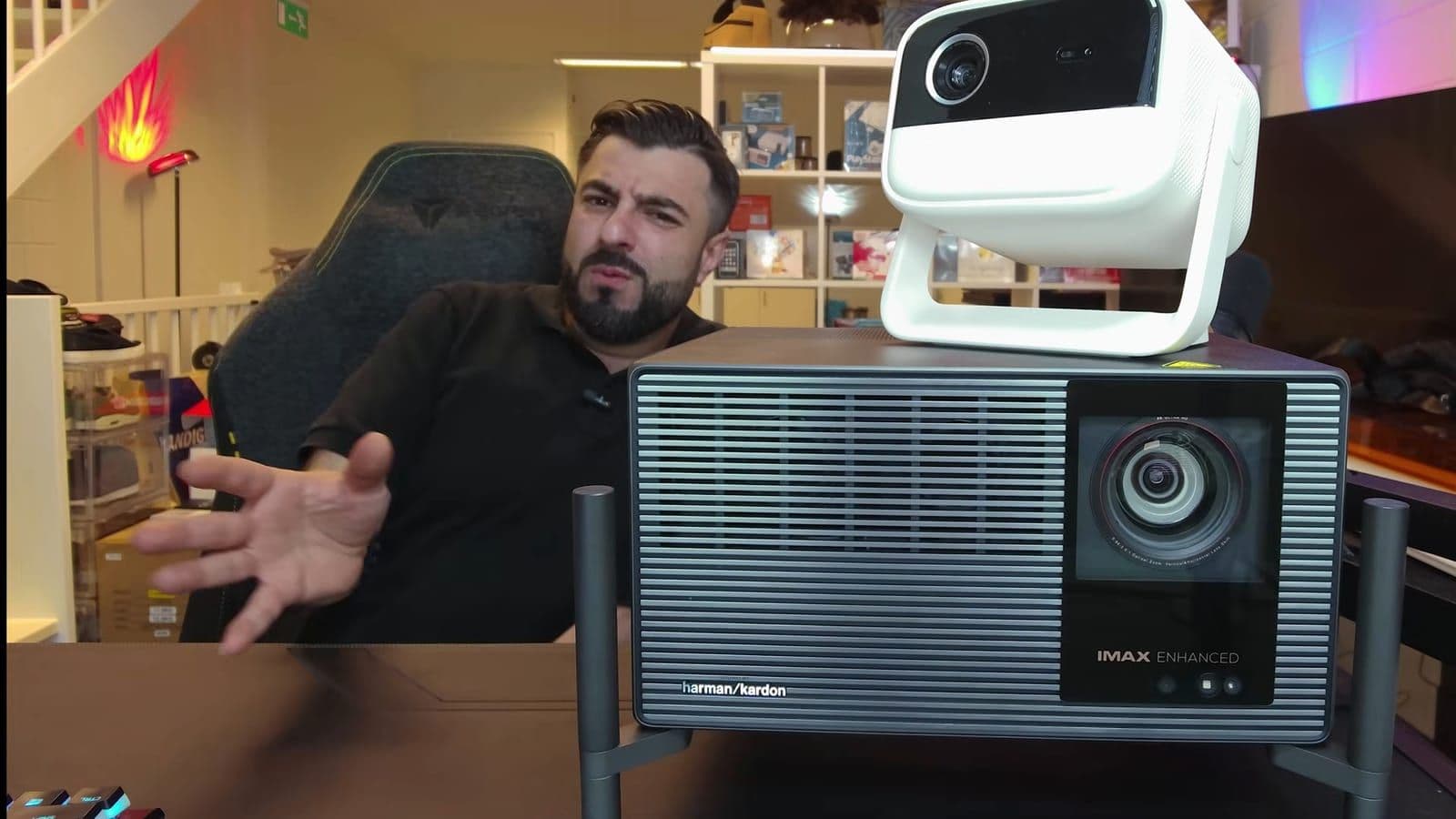
Ik testte de Toumei S7, XGIMI Horizon 20 Max en Titan Noir Max zij aan zij op een 133 inch ALR-scherm. Dit is wat een projector van $6.000 echt toevoegt.
Bekijk de video op YouTubeSommige links op deze pagina zijn affiliate links. Koop je via zo'n link, dan krijgen wij een kleine commissie. Jij betaalt niets extra.
Spending $6,000 on a flagship projector like the XGIMI Titan Noir Max gets you noticeably deeper blacks and better three-dimensional depth, but the $3,000 XGIMI Horizon 20 Max delivers roughly 85% of that performance for half the price. Meanwhile, throwing a budget $500 projector like the Toumei S7 onto a low-gain ambient light rejecting screen is a waste of time, as it simply lacks the lumens to punch through the dark material.
After my standalone review of the Titan Noir Max, my comment section said the exact same thing over and over. As I put it: "Zino, you need to test this on a proper projector screen before we can really judge it. And honestly, that's a fair point." Projecting onto a plain white wall hides what high-end optical engines can actually do. So I put three projectors side-by-side in the same room, fed them uncompressed high-bitrate video files, and recorded the results.
How the side-by-side comparison was tested
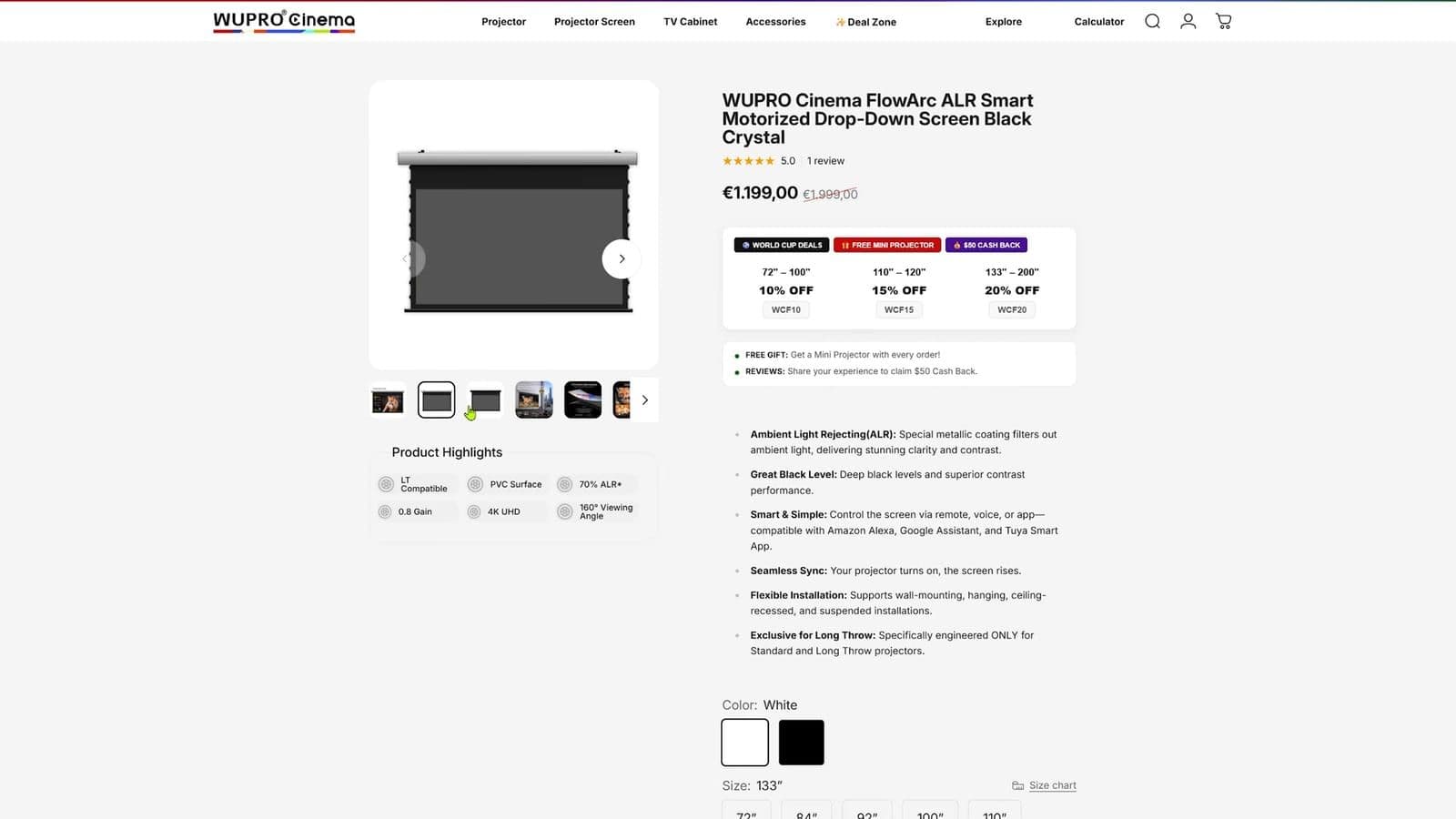
To keep this fair, every single variable except the projectors was locked down. I projected onto a WUPRO FlowArc 133-inch Black Crystal ALR Smart Motorized Drop-Down Screen. On 10 June 2026, this screen was listed at €1,199.00 down from its original €1,999.00. It uses an ambient light rejecting surface with 0.8 gain that filters out up to 70% of ambient light, which dramatically improves contrast compared to a white wall.
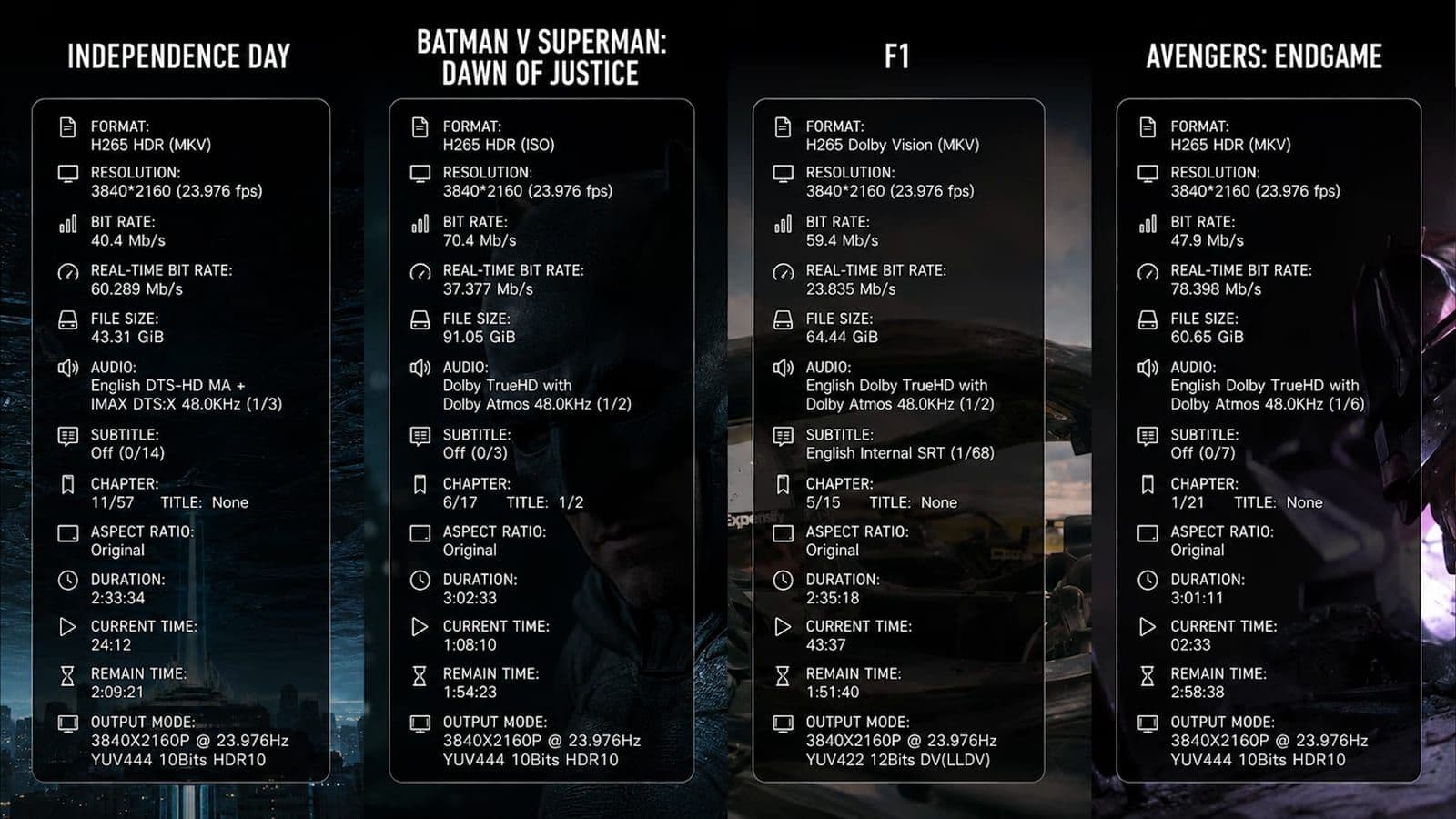
All video files were played uncompressed via a Zidoo Z9X 8K media player. I picked four heavy 4K UHD Blu-ray remux files to push dynamic range and color bit depth:
- Avengers: Endgame (4K HDR10, 3840x2160, ~80 Mbps bitrate, 60.65 GB)
- F1 (4K Dolby Vision, 3840x2160, LLDV output, 64.44 GB)
- Independence Day (Native 4K HDR10, 3840x2160, 43.31 GB)
- Batman v Superman: Dawn of Justice (4K HDR10, 3840x2160, 91.05 GB)
Filming projectors is notoriously difficult because camera sensors can introduce rainbow effects or slight flicker that you never see with your own eyes. I filmed everything using a DJI Osmo Pocket 3 locked at 4K 25fps, 1/60 shutter, and a white balance of 3700K. For the two XGIMI models, ISO was locked at 200. But the Toumei S7 was so dim on this dark screen that I had to change settings: "I had to quadruple the ISO to 800 just to show what I was seeing with my own eyes."
Do long fiber optic HDMI cables degrade projector image quality?
Because I had to set up three projectors across different throw distances in the room, I ran RUIPRO 8K Fiber Optic HDMI cables in 20-meter, 30-meter, and 50-meter lengths. Long passive copper cables usually drop 4K HDR signals or introduce sparkle artifacts once you go past 5 to 7 meters.
The 30m and 50m RUIPRO cables have detachable ends. You unscrew the full-sized HDMI connector to reveal a tiny micro connector that pulls through standard wall conduit without snagging. As I noted during the setup: "That means you don't have to drill massive holes just to fit an HDMI plug through a wall." You can also swap the ends for DisplayPort or Gigabit Ethernet adapters if needed.
I swapped the 20m, 30m, and 50m cables between all three projectors throughout testing. "I tested all three cables on all three setups and exchanged them multiple times, and there was no difference at all." If you need long in-wall runs for a dedicated home theater, fiber optic is the only sensible choice.
Side-by-side picture quality across four 4K movies
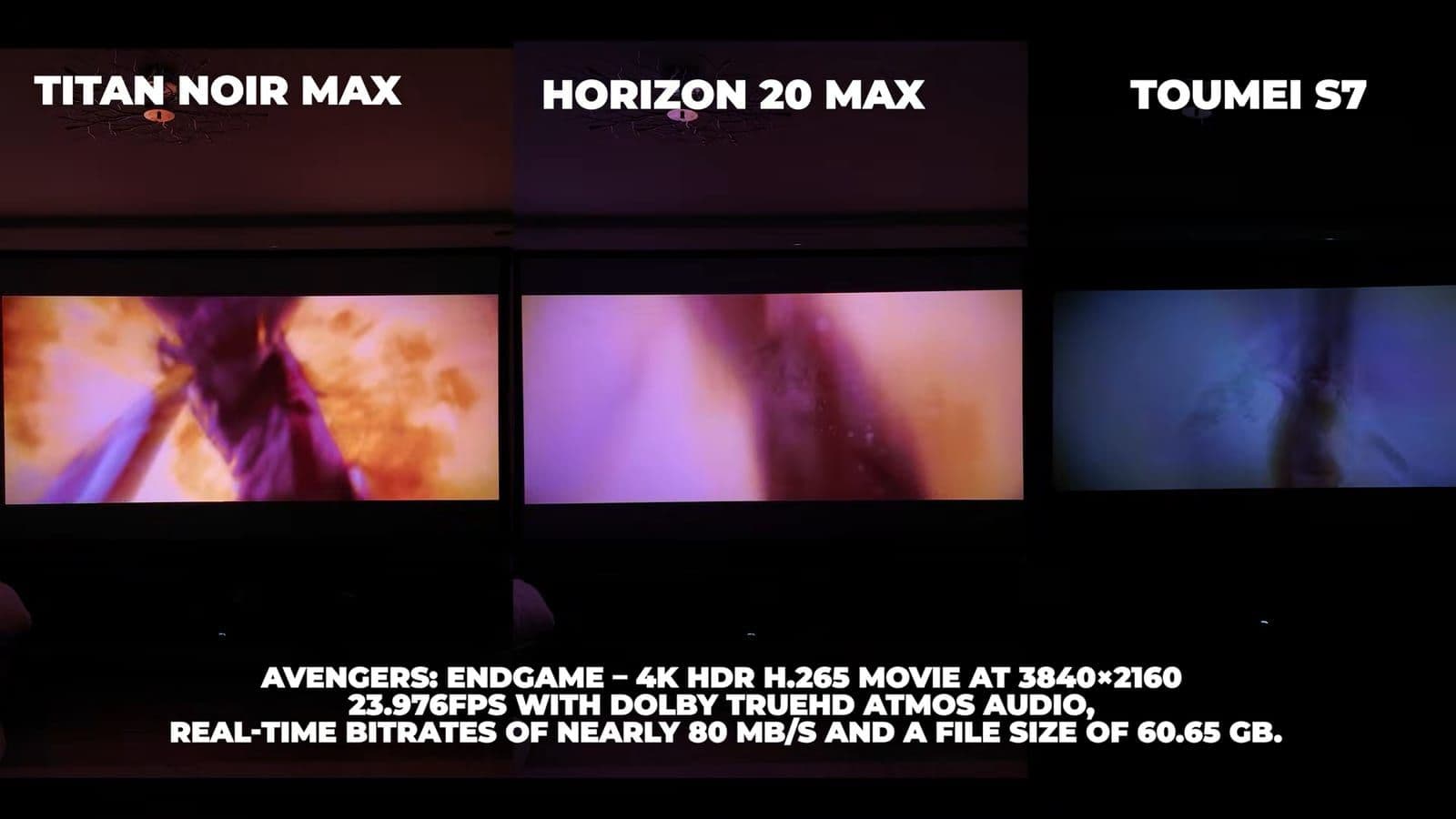
When you play high-bitrate HDR files side-by-side, the price differences become obvious within seconds. In the explosion sequence from Avengers: Endgame, the Titan Noir Max showed clean separation between blinding fireball highlights and dark debris. The Horizon 20 Max was close behind with rich colors and great sharpness. The Toumei S7 looked like a completely different movie, with dull colors and crushed shadows.
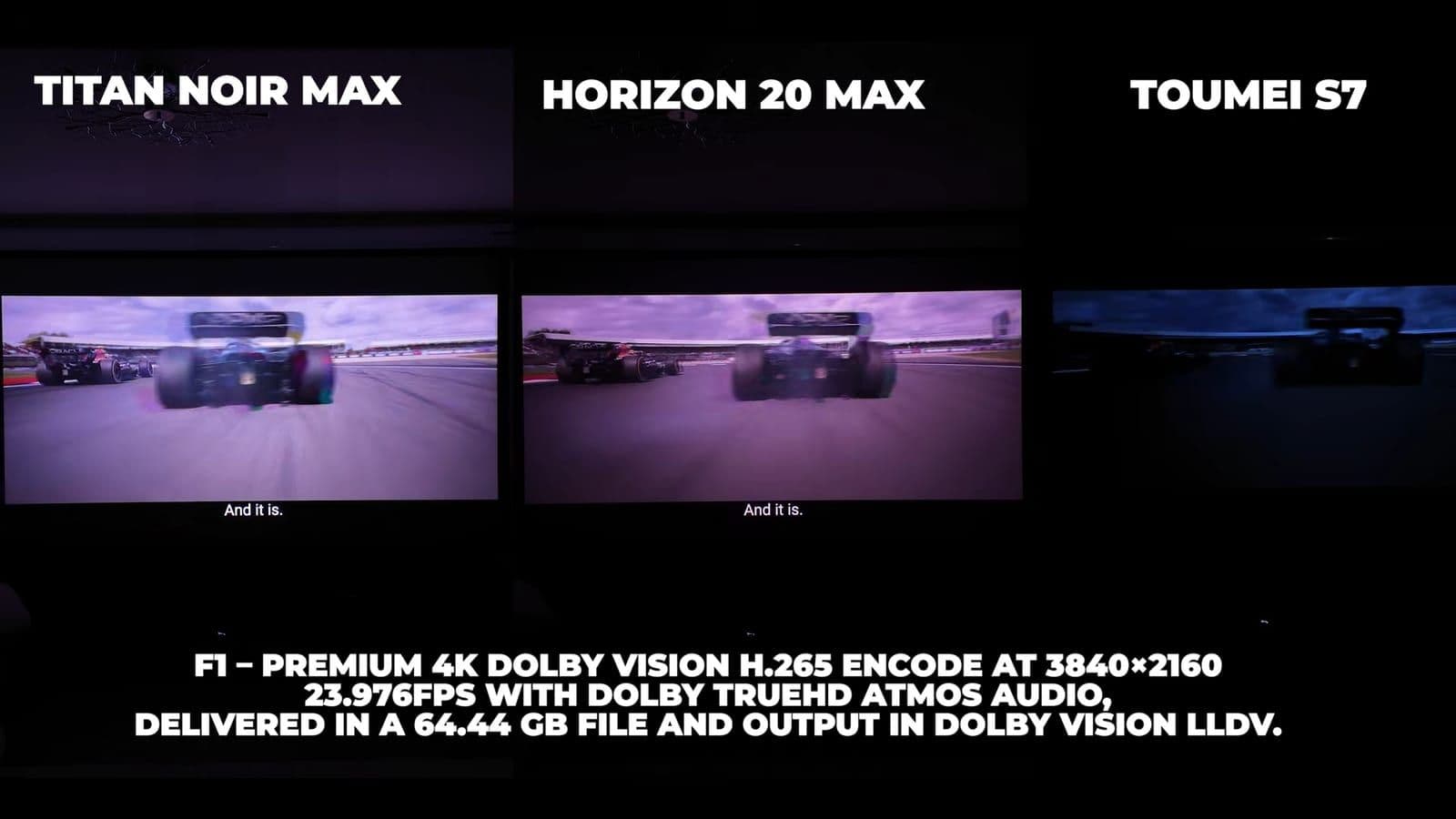
The F1 cockpit sequence demonstrated contrast and motion handling. The Titan Noir Max handled the fast-moving track reflections and sky exposure with noticeable precision. "The reason why it wins is not just because it's brighter, it's the full image. The image has more depth." The Horizon 20 Max handled the track texture very well, maintaining natural mid-tones without blowing out specular highlights.
During Independence Day and the dark Knightmare sequence in Batman v Superman, the Toumei S7 struggled severely. Its 600 ANSI lumens could not cope with the 0.8 gain ALR screen. Shadow detail vanished into murky gray-black patches. By comparison, both XGIMI units pulled fine texture out of Batman's dark coat, though the Titan Noir Max delivered noticeably darker black bars in letterboxed scenes.
Is the $6,000 Titan Noir Max worth the price gap over the Horizon 20 Max?
"The Titan Noir Max wins here. I mean, let's be honest: it's the most expensive projector in this comparison." It provides the best black levels, the highest contrast, and the cleanest HDR highlight control I have tested from a consumer projector. If you have an uncompromising theater room and a large budget, you get what you pay for.
Yet, "the Horizon 20 Max is still an amazing choice and probably the sweet spot for a lot of people." I daily-drive the Horizon 20 Max at home, and watching it right next to a projector that costs twice as much did not change my mind. The gap between $3,000 and $6,000 is subtle nuance: slightly inkier blacks, a bit more dynamic pop in highlights, and deeper color gradations. It is not twice as good.
As for the budget tier: "With the Toumei, you can still watch movies, I mean, it works, but compared to the other two, the image is much darker." If you buy a $500 projector, do not pair it with an ambient light rejecting screen. ALR screens absorb light by design, and budget units simply do not have the power to push through them.
Who should buy which projector?
Buy the Titan Noir Max if:
- You have a dedicated, light-controlled media room.
- You want the deepest possible black levels and highest HDR dynamic range.
- A $6,000 price tag fits comfortably inside your home theater budget.
Buy the XGIMI Horizon 20 Max if:
- You want high-end 4K HDR projection without spending five figures.
- You watch movies regularly in a living room or multi-purpose space.
- You want the sweet spot between top-tier performance and reasonable spending.
Buy the Toumei S7 if:
- You have a strict $500 budget for casual movie nights.
- You project onto a plain white wall or a standard high-gain white screen in a fully dark room.
- You are not expecting home cinema black levels or HDR brightness pop.
Skip all three of these projectors if you need an ultra-short-throw model that sits directly against the base of your wall, or if you need a tiny battery-powered projector for camping.
Frequently asked questions
Is the XGIMI Titan Noir Max worth it over the Horizon 20 Max?
For most home cinema buyers, no. While the Titan Noir Max provides superior black levels, punchier specular highlights, and better image depth, the Horizon 20 Max gets you roughly 85% of that visual performance for roughly half the price.
Can you use a budget projector on an ALR screen?
It is generally not recommended. Ambient light rejecting screens usually feature dark material and lower gain ratings (such as 0.8 gain) to absorb stray light, which requires a bright light source. A budget unit like the Toumei S7 at 600 ANSI lumens ends up looking dark and washed out on an ALR screen.
Does HDMI cable length affect 4K projector picture quality?
With high-quality fiber optic HDMI cables like RUIPRO, length does not degrade image quality. In my side-by-side tests swapping 20-meter, 30-meter, and 50-meter fiber runs with 80 Mbps 4K HDR Blu-ray files, there was zero difference in sharpness, color reproduction, or signal stability.